Some things I read just scream out for commentary, even if there isn't time for a lot. Today I happened to see a reference to an article in the English version of the Chinese People's Daily Online (http://english.peopledaily.com.cn) -- who knows if it is the same as the Chinese version? -- entitled "Dongguan's dilemma: labor shortage vs job-hunting difficulties" that talks about how factory owners are having a hard time finding workers at the prevailing wage. The economist in me wonders, "why don't they increase wages, then?" and the article notes that the firms don't feel they can increase wages because of price pressures. The interesting thing is that the Chinese wages are always referred to as the culprit in why wages can't increase in places like the US, yet here the Chinese are talking about prices pressures, presumably at least some from outside China. Hmmm.
While on the page, I saw a few other interesting article titles referring to areas/countries in which I have an interest: "Baby alien found by Mexican farmer," "Why India is pursuing military strength?" "India's Media Stinks Up Public Opinion," and "How do India's Middle School Textbooks Portray China" -- all of which refer to bulletin board debates, the quality of which are themselves debatable. But Asian analysts certainly can pay attention to these kinds of places to track at least one slice of public opinion.
Thursday, September 17, 2009

Saturday, September 5, 2009
Jane Jacobs and Robert Moses
As we ponder appropriate urban development strategies in the booming cities of India, reconsideration of fights between alternative positions in the "urban renewal" fights in New York. Always insightful Edward Glaeser reviews a new book by Anthony Flint entitled Wrestling with Moses: How Jane Jacobs Took on New York's Master Builder and Transformed the American City in an articled published on September 4, 2009 in The New Republic. It is worth a read for those interested in urban development -- which means anyone interested in India, or China -- as well as the rest of us who will be affected by development in those areas. He concludes by saying that cities need a combination of Jacob's humanism, concern for pedestrians, and creating opportunities for random (positive) encounters in vital human-scale neighborhoods, and Moses' concern for building of long-lasting and needed infrastructure.
I see this tussle everyday as I read about what is happening in Bangalore, and Mumbai. Yes, one laments huge high rises that intimidate, yet only low buildings lead to prices that are unaffordable for mere mortals, combined with lack of alternatives yet a demand for low-skilled labor, leads to expansion of slums. You will certainly read more about this in the future, at least if you keep reading this blog, as this topic is something I am spending more time on at work these days.
I see this tussle everyday as I read about what is happening in Bangalore, and Mumbai. Yes, one laments huge high rises that intimidate, yet only low buildings lead to prices that are unaffordable for mere mortals, combined with lack of alternatives yet a demand for low-skilled labor, leads to expansion of slums. You will certainly read more about this in the future, at least if you keep reading this blog, as this topic is something I am spending more time on at work these days.
Monday, August 31, 2009
A couple of gems from today's newspapers
DNA Money has a headline of "India set to be the best performer among BRICS" but the only country other than India mentioned is China. This is pretty typical of much of the discussion and coverage of the "BRICs" -- for those of you who are confused, BRICs is an acronym coined by an analyst at Goldman Sachs a few years ago to refer to the growing markets of Brazil, Russia, India, and China, hence BRIC.
Meanwhile, the Hindu op-ed page has a piece by none other than Fidel Castro entitled "The empire and the robots" that is Fidel at his best, attacking the US government and ask why special interests emerge to block health care reform every time it is close. He's clearly feeling better.
Meanwhile, the Hindu op-ed page has a piece by none other than Fidel Castro entitled "The empire and the robots" that is Fidel at his best, attacking the US government and ask why special interests emerge to block health care reform every time it is close. He's clearly feeling better.
Sunday, August 30, 2009
Capturing a slice of the great recession in the US
This video by Stewart Thorndike, shown via the New York Times, shows life in a tent city in Redmond, Washington. Yes, down the street from Microsoft. It talks about how these are better than traditional shelters in buildings, and how there seems to be some formalized governance (and jobs running it and keeping it clean) that are often lacking in more impromptu settlements, and also how there are showers and bathrooms. It does not talk about whose land used, and how they first emerged. Seems like most of the tent dwellers lost their job (many of those interviewed were refugees from Arizona), run down their savings, and landed up in the tent city. They didn't look like the folks we are used to seeing living in these impromptu settlements in the US, often people with addiction problems and few skills. Depressing.
Overloaded trucks, part 1
Some scenes from roads around Bangalore mainly. I need to have my camera ready to capture some of the effects of these overloaded trucks: overturned vehicles, non-steady turns, very slow-moving traffic.


 It's not just trucks that are overloaded, either. Buses, cars, everything. Of course, I suppose that the concept of "overload" is situation dependent.


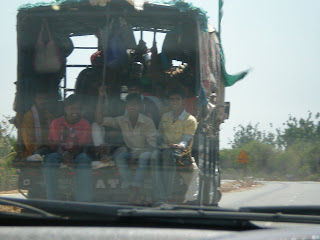 Somehow it bothers me less when it is non-mechanized vehicles, like below, although it must shorten the active life as well. This is not in the city, but outside of Bangalore.
 I'm keeping my eye open for more of these scenes. This relationship with "full capacity" can have serious implications as calculations occur for needed transportation infrastructure.


 It's not just trucks that are overloaded, either. Buses, cars, everything. Of course, I suppose that the concept of "overload" is situation dependent.


 Somehow it bothers me less when it is non-mechanized vehicles, like below, although it must shorten the active life as well. This is not in the city, but outside of Bangalore.
 I'm keeping my eye open for more of these scenes. This relationship with "full capacity" can have serious implications as calculations occur for needed transportation infrastructure.
Friday, August 28, 2009
Trying to avoid swine flu at school
 Before starting school, every student needed to get checked for swine flu. This repeated a scene from the airport too -- upon arriving in India, a nurse takes your temperature with one of these Star Trek like contraptions that only needs to get near you!
 Waiting in line. Long lines.

Tuesday, August 25, 2009
summer 2009 in America
 Commemorating Obama's election, and lamenting Michael Jackson's death. Magazines on the rack at the grocery store in Niagara Falls in early August.
 Vanity Fair saluted two American icons who died. A sign of change in Niagara Falls -- Vanidades, a woman's magazine in Spanish.
 Easy to see signs of the great recession -- folks lining up for the food bank truck, checking the racks of donated clothing, and signing up for additional services.
 Sad that there are so many people signing up, and needing these services. On a more positive note, these services exist, something that I appreciate so much more after being in India.
Subscribe to:
Posts (Atom)