Showing posts with label housing. Show all posts

Saturday, November 28, 2009

Land in North Bangalore Part 1, with some background

Roses growing in North Bangalore. The land is very rich, and this region has been a center of flower and agricultural.
One farmer we visited is expanding his production, using techniques taught him by the agricultural university. More on this later, as it is worth its own posting, but this time we're focusing on the land, and the transformation.

Power lines above ...

Lately I've gone for some rides in North Bangalore, looking at various plots of land, and watching the development process. This confirms the non-planned, totally random process of expansion of Bangalore that one sees in the metropolitan area spreading out further and further.

For some background, WIRED magazine in late 2008 published a frightening article entitled "The Godfather of Bangalore" by Scott Carney about the land mafia. Here's a blurb from Scott's blog "www.scottcarnegyonline.com" (which makes for fascinating reading) with which I agree:
In my view, Bangalore isn't only an example of the best that India has to offer. Instead Bangalore shows how the worst elements of Indian society can co-exist with a ultra high tech and modern image. Bangalore today isn't much different than it was three hundred years ago when kings ruled the land. The kings of today are power brokers, IT captains of industry, underworld dons and government ministers who play by their own rules. Bangalore isn't neo-colonialist as some people have claimed. It's neo-feudalist.
The feudalism theme is relevant in many, many spaces, especially when talking about land, land transfer, ownership, and development. The pictures below track the process of residential development, a theme I've mentioned before and will continue to follow.

Agricultural land gets "converted" and "released for development" by various processes, but one is never sure the land titles are valid. I have heard multiple horror stories of folks buying land, and even building, only to be told that the original transfer wasn't valid -- and this after lawyers, officials, and more lawyers have given their opinions. Land disputes hold up both good and bad projects.
Plots of land tend to have the "no trespassing" sign, a wall around them, and a little hut for someone to live in while they watch/defend the land. Larger developments of course have bigger fence and more impressive guardhouses.
This is the outside guardhouse being built. Inside the fences, you see the basic infrastructure being laid out, and buildings going up.
The road inside the layout.
Pipes to build it.
And the women working, as usual, harder than the men.

Here is another development - townhouses and apartments -- further along.
We arrived at the end of the day, so kids were home from school (yes, we asked, and the kids were Kannada speakers, probably from North Karnataka, whose parents were working on the project, and they told us about their school).
OSHA would have a field day.
Modern construction equipment is used side-by-side old (dare I say ancient) techniques.
The little girl in the blue is in 2nd standard/grade. They were thrilled to see themselves when I showed them their picture.

Booming Indian cities like Bangalore are surrounded by ads like this, and then the complexes they promise -- although the complexes generally don't look *exactly* like the mock-ups.
Now, here is what it looks like right now:
I like the scare-crow on the top of the first house. Outside the walls, here is the agent showing some of my friends the layout. Note the nice office/guardhouse behind. This belongs to the previous billboard complex.
In another area, we saw a turkey - appropriate for this Thanksgiving Day weekend posting.
Below is the temporary housing built for the workers building the complex. As far as this type of housing goes, this isn't bad.
These are the houses they are building:
Now, the land rush around Bangalore means that deals need to be cut. We have neighbor who is a land wheeler and dealer. When his business colleagues come over, the kids lose their cricket space, and the drivers menace all of us.
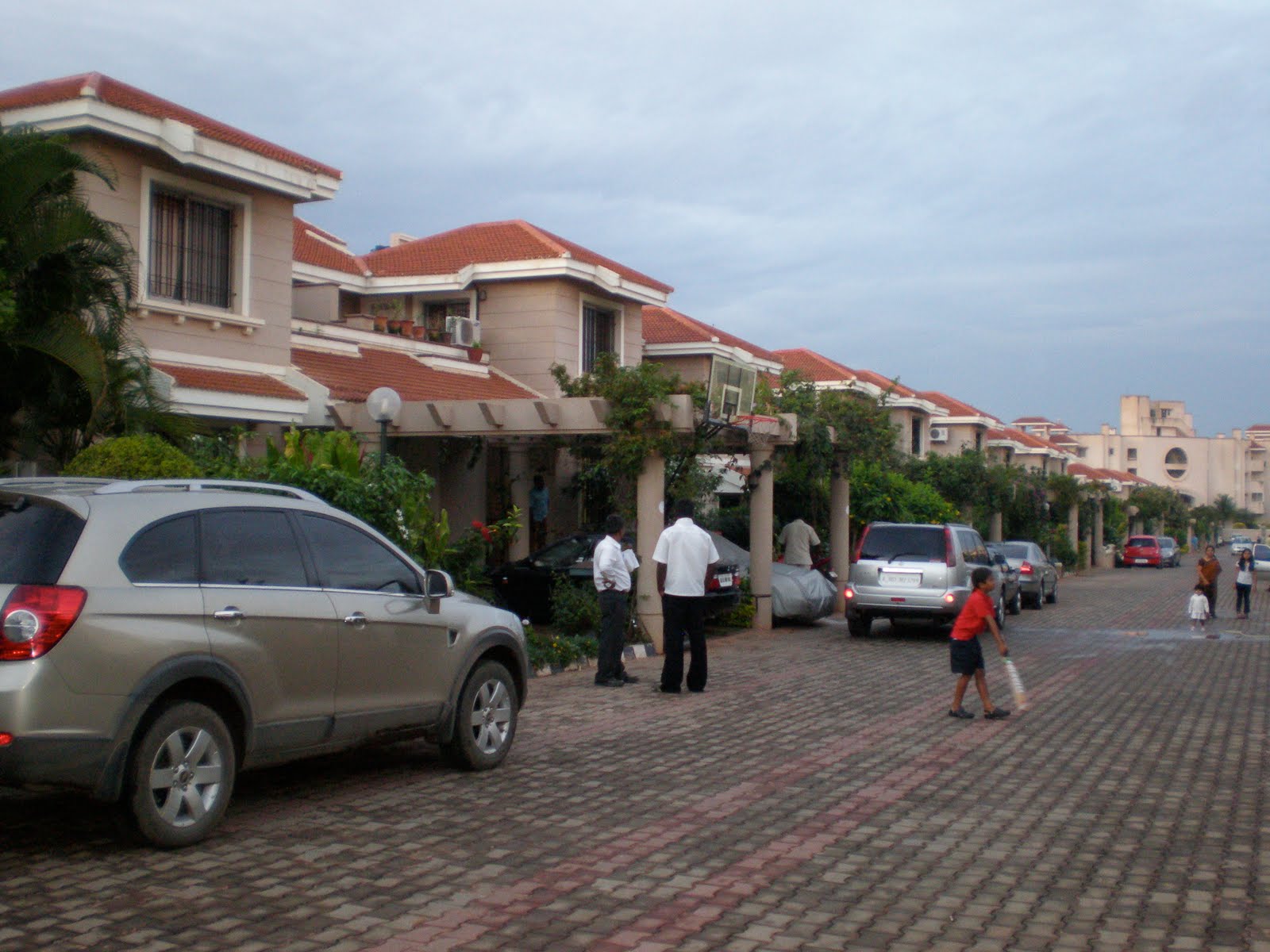
These folks give me the creeps.
So as not to close on a negative note, we see lots of schools and girls attending them, which means that not all is lost.
Girls leaving school.
Students leaving the school to walk, go to the bus stop, or bike home.

Monday, November 9, 2009

Scenes along Bellary Road, late October 2009

Here are shots of some scenes around Bellary Road, near our house. This is one of the major arteries here in Bangalore, the one that links downtown with the new airport. One of the goals is to make it "signal free" for cars to make the trip faster, but there people need to get across it too, and even cars need to get on and off, and make turns. One can see some of the needs of India, just in this small section.

This is the scene on the access road -- shared by cars (going in both direction), motorcycles, pedestrians, three wheelers, bikes, folks carrying plants in their head, an open drain on the left.
A wider lense -- you can see some women gathered in a building that had been broken in half (later I'll dig up my earlier pictures of this space, which has slowly become occupied by more and more squatters) by road expansion.
By this building is a big pile of bags of charcoal, sold for 40 rupees a bag, principally to the ironing men and women (generally men, aided by women) in the area.The bags were used for something else before. Bags get used and reused here.
One of the problems along this road, and throughout Bangalore, is drainage. Here we have open drains that are horribly polluted. In addition, one regularly hears about children falling into them and getting sick in some cases, and drowning in others.

Here you can see the stones used to "cover" the drains in some places.
Next, I'll turn to the use of tools. We have dug up much of the grass in our backyard to put in a garden -- flowers, herbs, and veggies we can't always find (for example, lettuce, cherry tomatoes, parsley)-- as well as fill up some planters, so we wanted to get more soil. We went to the nursery at the side of the pile of coal (itself on the side of the house cut in half), and these two women attended to us, dressed in their silks, scooping up the dirt with their bare hands, no tool anywhere in sight. Lack of anything more than basic tools is clearly limiting productivity, which limits wages, and round and round.

Now onto traffic. You probably don't notice the great innovation here, but there is actually a "walk/don't walk" signal, although it would be hard to depend upon it. On this road one regularly sees drivers blowing through stop lights, and just today we were stopped at a stop light and the driver behind us was beeping non-stop -- it was a government official's car.
A walk signal!
At each stop light one sees the pattern of motorcycles (or two-wheelers, as they are called here), weaving through to get to the front of the pile of cars stopped at the stop lights.
A policeman giving a citation. Well, maybe. Turns out that often the policeman stopping the traffic doesn't have the authority to turn the citation over, for that he needs his supervisor to come, and sometimes that might take a while. Hmm, sounds like a great time for and "arrangement" between these two, don't you think?
Then there is the loading of trucks on the road, overloaded and poorly maintained, so that occasionally they just poop out in the middle of the road, and remain there for hours and hours.
This is an old theme for me, but one that I never tire of documenting.
At least the cardboard is getting recycled.


Fairness cream is a big thing here -- now that it is getting colder, they are advertising for "winter fairness cream". There are separate creams for women and men, with no less than Shah Rukh Khan, one of the reigning kings of Bollywood, advertising the male version.
The world intervenes: signs for H1N1 in English. There are Kannada versions in other places.

Sunday, June 28, 2009

Land grabs blocking public roads in Jakkur

This is what the path to Jakkur village looked like last September 2008 (I think I even posted this picture before). Not lovely, but at least there is a passage for villagers to get to the main road.
The construction site decorated for Dassara.
The path to the village can be seen beyond the mango leaves to the left.
These huts were around the corner from the mango leave'd entrance to the construction. Slowly the building is going up, but now both the building and others (unknown at this point) have enclosed the space -- where there was a road once upon a time connecting the village with the main road. Here are the pictures of the scene today:
Some women scaling the wall nearby to try to get to their village (you can see them in the middle in pink and green saris):
The well remains in the far corner of the plot, but the path to the village has been shut off by the corregated metal fence. You can see where the path used to be where the brick wall ends.These women were trying to get back to the village. Sub intervened with the security guard (generally from the North, so Hindi-speakers) to open the locked "secret door" to make their return home easier.
The guard finally unlocked the door for them.
Tomorrow in the office I need to check the Master Plan and see if this space is supposed to be a public road (which I believe it is). If it is not, it should be, as the villages that are being consumed by Bangalore's growth get locked in, people are cut off from walking and easier access to public transportation, and space that should be public gets taken over (not even privatized, just stolen).